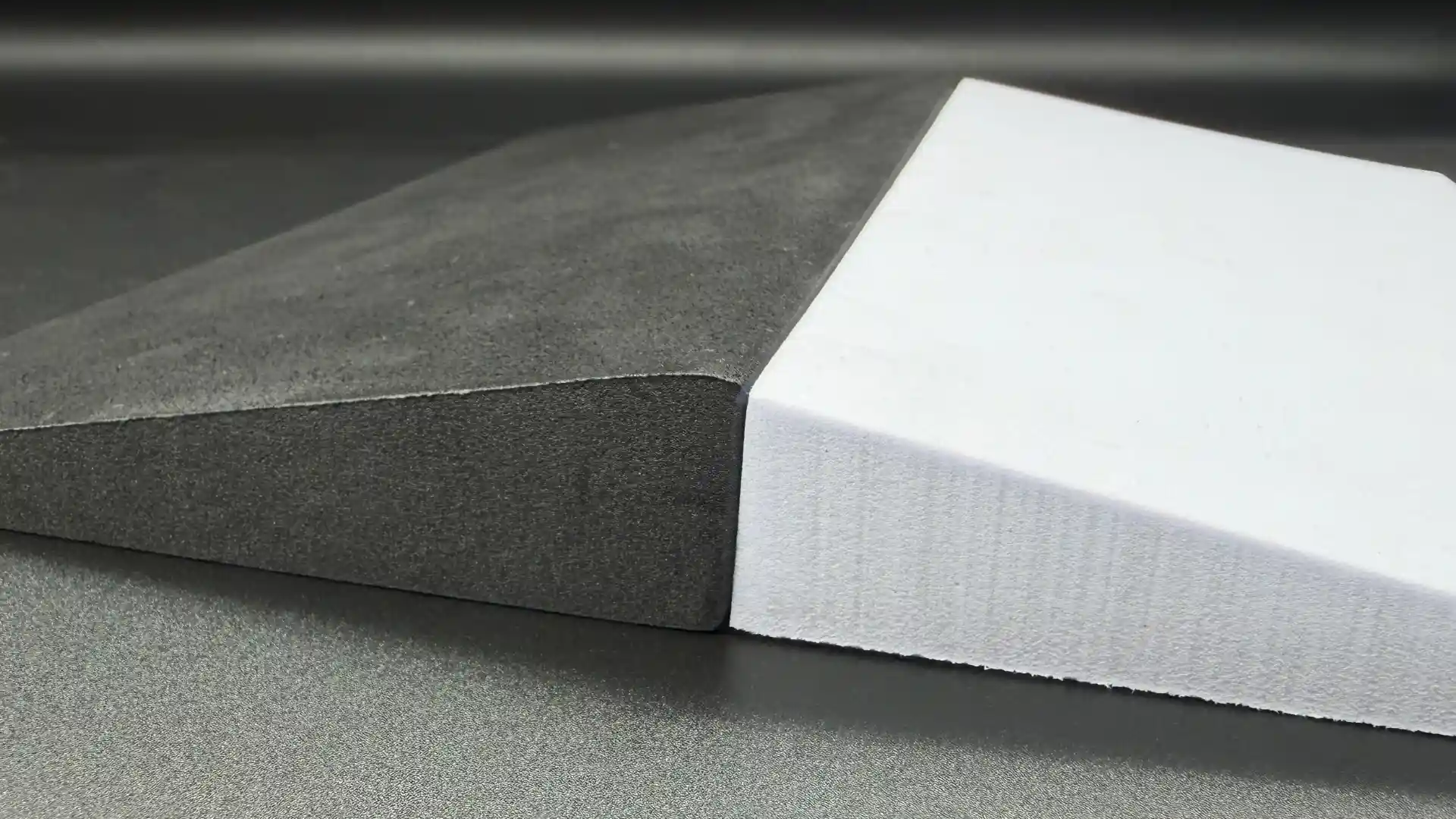
Wedge-Shaped Custom EVA Foam Parts: Two Manufacturing Processes Compared
Wedge-shaped foam components are everywhere once you start looking for them: under insoles, inside tool cases, beneath machinery, between stacked panels. Yet a true precision wedge — one that tapers smoothly from 25 mm down to a 1 mm edge — is far harder to manufacture than a simple rectangular pad. The material compresses, the blade drags, and the thinnest edge of the part is also the one most likely to come out wrong.
In this article we take one real product and show how it can be produced with two completely different processes: bevel cutting (Process A) and CNC wire cutting (Process B). Same material, same dimensions — different surface finishes, different edge character, and different strengths. If you are sourcing custom EVA foam parts, this comparison will help you choose the right process for your design.
Product at a Glance: A Precision EVA Foam Wedge
The part used for this comparison is a wedge-shaped custom EVA foam component with the following specifications:
| Parameter | Value |
|---|---|
| Length | 280 mm |
| Width | 120 mm |
| Maximum thickness | 25 mm |
| Minimum thickness | 1 mm |
| Taper angle | ≈ 4.9° (arctan(24 ÷ 280)) |
| Hardness | Shore C 60 |
| Weight | approx. 55 g |
| Calculated density | approx. 0.126 g/cm³ (126 kg/m³) |
| Material | Closed-cell micro-cellular EVA foam |
How the density is calculated: for a linear wedge, the average thickness is (25 mm + 1 mm) ÷ 2 = 13 mm. The nominal volume is therefore 280 × 120 × 13 mm = 436,800 mm³, or 436.8 cm³. Dividing the 55 g weight by this volume gives approximately 0.126 g/cm³, or 126 kg/m³. This is a theoretical value based on nominal dimensions and weight; actual batch density is verified during foaming. At roughly 126 kg/m³, the part sits in the semi-rigid range typical of EVA foams used for structural cushioning and load-spreading applications.
Understanding the Material: EVA Foam vs. PE Foam
Before comparing the processes, it is worth clarifying the material itself, because EVA foam and PE (polyethylene) foam are constantly confused — and not without reason.
Why PE Foam and EVA Foam Get Mixed Up
The two materials overlap in practice because manufacturers routinely blend them:
- PE foam formulations often add EVA to improve elasticity and toughness, making the foam softer and more resilient.
- EVA foam formulations often add PE to raise hardness and rigidity, giving the foam more structural support.
The result is a spectrum of blended foams where a “PE foam” may contain a significant EVA fraction and vice versa. In our specifications, we define the material by its dominant resin system and verify it through measured properties — hardness (Shore C 60), density (~126 kg/m³), and cell structure — rather than by name alone. When you request a quote for a custom foam part, always ask the supplier which property envelope they guarantee, not just the material label.
Closed-Cell Micro-Cellular Foaming
This wedge is produced with a closed-cell micro-cellular foaming process. “Closed-cell” means each gas bubble in the foam is fully sealed off from its neighbors. The practical consequences matter for a precision part:
- Very low water absorption — the part will not swell or gain weight in humid environments.
- Uniform, fine cell structure — a consistent internal texture that machines cleanly and predictably.
- Good cushioning with shape recovery — the cells act like tiny sealed springs.
- Clean machined surfaces — fine cells produce smoother cut faces than coarse-celled foams.
These properties are exactly why closed-cell EVA can be machined into a 1 mm thin edge at all — an open-cell sponge of the same hardness would simply tear.
Process A: Bevel Cutting — Smooth Surface, Sharp Geometry
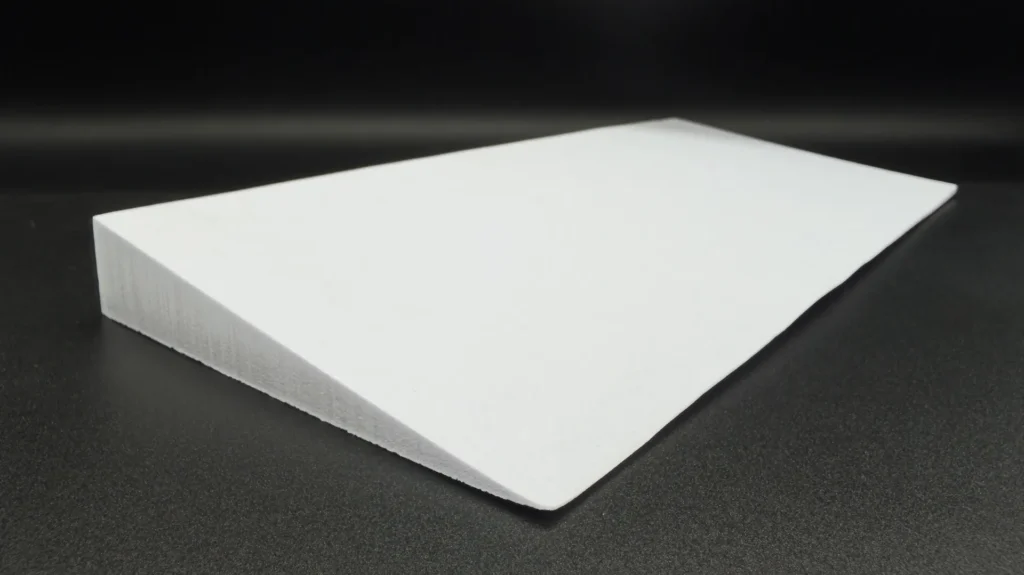
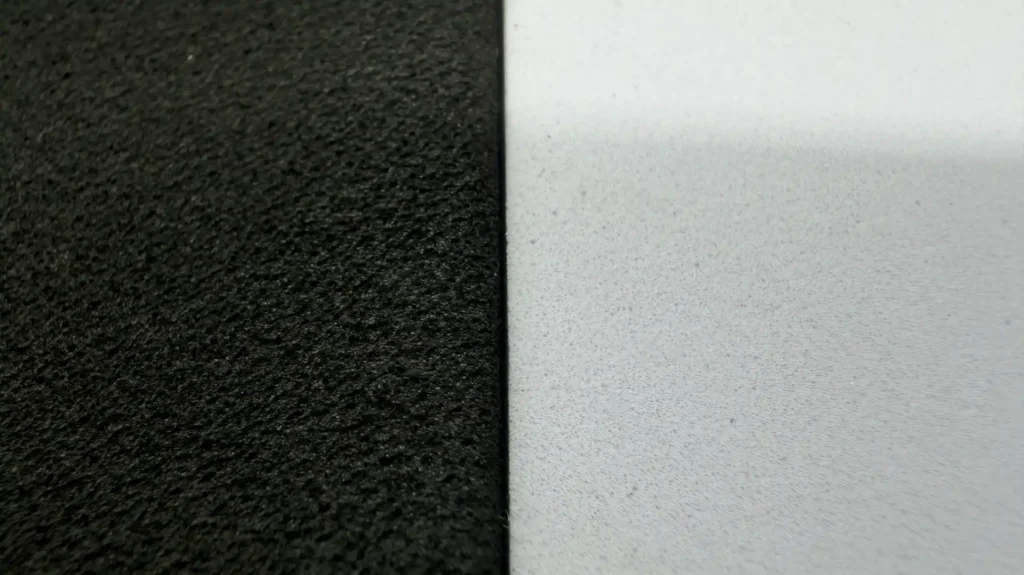
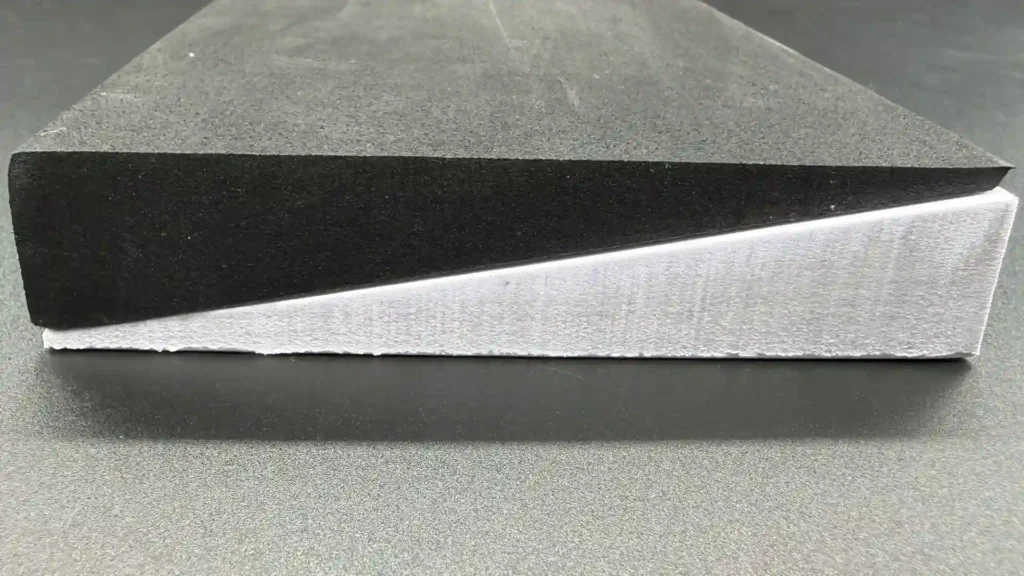
Process A uses a bevel cutting machine (also called an angle cutting machine or wedge cutting machine in the foam industry). The part comes out white with a smooth, almost glossy surface and sharply defined edges and corners.
How Bevel Cutting Works
The principle is mechanical and elegant:
- A dedicated fixture (jig) is built at the exact angle of the required taper — for this part, approximately 4.9°.
- The raw EVA foam sheet is clamped in the fixture and presented to the machine at that precise angle.
- A high-speed rotating circular blade slices through the foam along the angled plane, removing material to form the wedge.
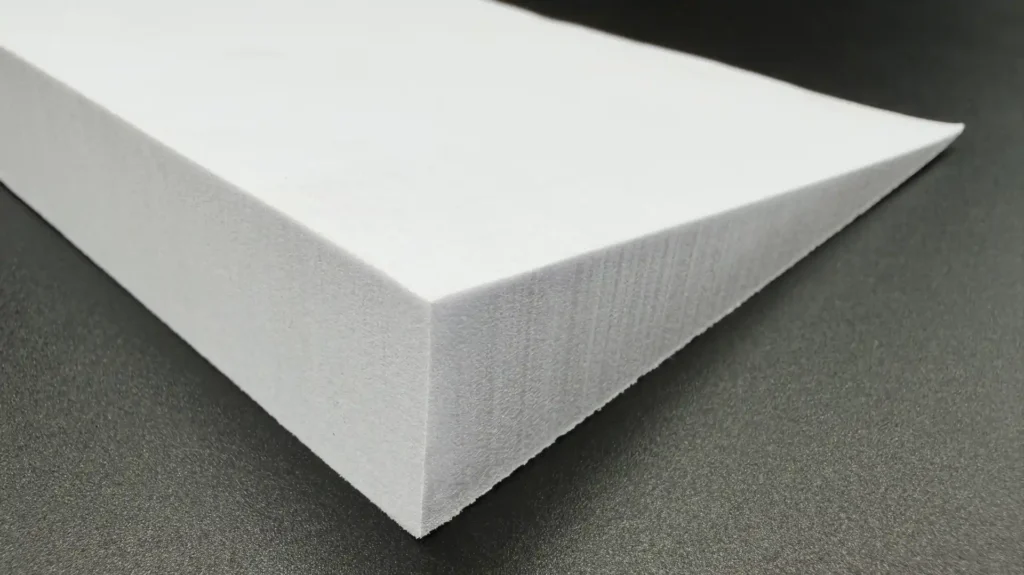
Because the blade cuts at high speed with minimal downward crushing, the resulting surface is smooth and the edges stay crisp. The geometry is defined by the fixture angle, which makes the process fast and repeatable once the tooling is right.
The Real Challenge: Fixture Accuracy vs. Elastic Deformation
Bevel cutting looks simple, but two things decide whether the part comes out right:
1. Fixture angle and tolerance control. The fixture must hold the sheet at exactly the designed angle, and the feed must be perfectly straight. A fixture error of even half a degree changes the thickness profile along the entire 280 mm length. Fixture rigidity, setup discipline, and blade alignment are the core of the process know-how.
2. Elastic deformation under clamping pressure. This is the deeper problem. EVA foam at Shore C 60 is elastic — when the fixture clamps it, the material compresses. The blade then cuts through the compressed shape. When the part is released, the foam springs back, and dimensions that were correct under pressure shift after release. Any cutting process that relies on pressure — clamping, pressing, slicing — introduces this kind of error, and softer, more elastic grades make it worse.
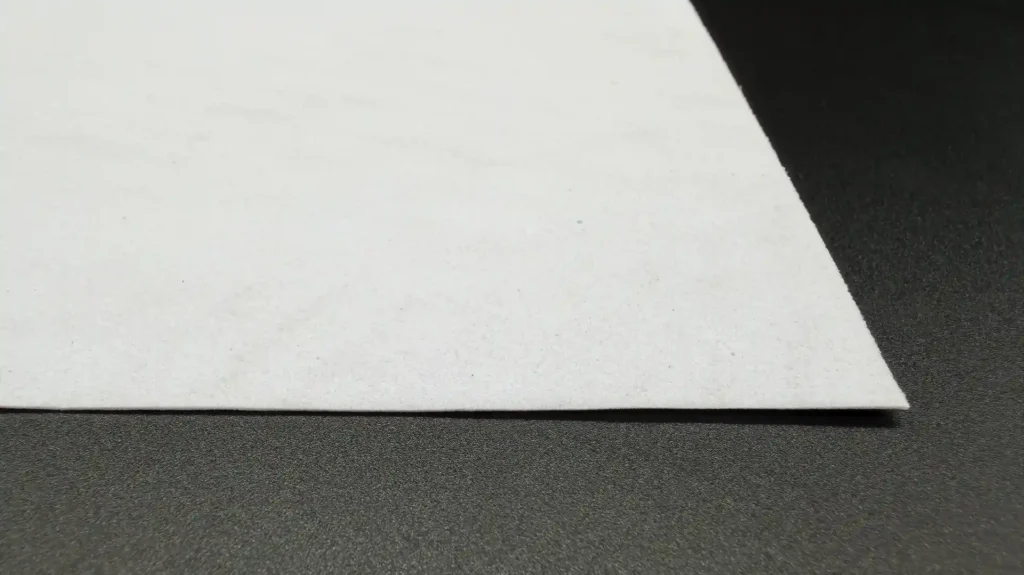
This effect is most visible at the thinnest region of the wedge. Bevel cutting can produce an impressively thin edge — 1 mm or even less — but the thin edge is also where thickness uniformity is hardest to hold: uneven clamping, blade drag, and spring-back all concentrate at the last few millimeters of the taper. For this reason, thin-edge parts require stricter process control and, typically, 100% inspection on the critical dimension.
Process A summary
| Aspect | Result |
|---|---|
| Color | White |
| Surface | Smooth, glossy |
| Edges / corners | Sharp, well-defined |
| Minimum achievable edge | Very thin (≤1 mm possible) |
| Main risk | Thickness variation at the thin edge; compression error |
Process B: CNC Wire Cutting — Rounded Edges, Complex Contours
Process B produces the identical wedge geometry from black closed-cell EVA foam using a CNC wire cutting machine (a computer-controlled wire saw — note that for foam this is a mechanical friction wire process, not the EDM wire-cutting used for metals).
How CNC Wire Cutting Works
Instead of a blade and a fixed-angle fixture, wire cutting is driven entirely by software:
- The wedge profile is drawn in CAD.
- A CNC control program plans the exact travel path of the cutting wire through the foam sheet.
- A thin, high-speed moving wire follows that programmed path, cutting the material by rapid frictional sawing action.
Because the cutting path is programmed rather than fixture-defined, the same machine can switch to a different part geometry in minutes — no new jig required. Complex outlines, cut-outs, and multi-step profiles that would need several fixtures on a bevel cutting machine come off a wire cutting machine in one setup.
Crucially, wire cutting applies very little compressive force to the workpiece. The wire saws through the foam rather than pressing against it, which largely eliminates the clamp-and-spring-back error that troubles blade-based cutting of elastic foams.
Why the Cut Surface Feels Plush
Two visible features distinguish Process B parts:
- Rounded edges and corners. The wire’s cutting action and slight lateral movement naturally round the corners rather than leaving a knife-sharp arris.
- A plush, fuzzy surface texture. As the wire travels, friction between the wire and the foam brushes and micro-tears the cell walls along the cut path, raising a fine nap. This velvet-like finish is characteristic of wire-cut foam and is sometimes even preferred for visible interior surfaces, since it hides minor handling marks better than a glossy cut face.
The plush layer is superficial — it does not change the part’s density, hardness, or dimensional stability. If a smooth finish is required on a wire-cut part, the surface can be skin-sealed, flame-treated, or laminated in a secondary step.
Process B summary
| Aspect | Result |
|---|---|
| Color | Black |
| Surface | Plush / velvety (wire friction texture) |
| Edges / corners | Rounded |
| Geometry flexibility | High — any programmable contour |
| Main strength | Near-zero compression error; fast changeover |
Bevel Cutting vs. Wire Cutting: Side-by-Side
| Criterion | Process A — Bevel Cutting | Process B — CNC Wire Cutting |
|---|---|---|
| Cutting tool | High-speed rotating circular blade | High-speed friction wire |
| Geometry defined by | Fixed-angle fixture | CNC program |
| Surface finish | Smooth, glossy | Plush, velvety |
| Edge character | Sharp corners | Rounded corners |
| Compression error risk | Higher (clamping deforms elastic foam) | Very low |
| Very thin edges | Excellent (≤1 mm), but watch thickness uniformity | Good, more forgiving on elastic material |
| Changeover to new design | New fixture required | New program only |
| Best for | High-volume single geometry, crisp sharp appearance | Complex shapes, low-to-medium volume, tight dimensional stability |
Which Process Should You Choose?
- Choose bevel cutting when the part is a simple taper or prism, volumes are high, and the design calls for sharp corners and a smooth, glossy face — and when your supplier has proven fixture and tolerance control for elastic materials.
- Choose CNC wire cutting when the geometry is complex or may change, when dimensional stability of elastic foam is critical, or when a soft-touch, rounded-edge part is acceptable or desirable.
- For the exact wedge described here, both processes deliver a functional part; the deciding factors are appearance, edge style, and how much tolerance risk you can accept at the 1 mm edge.
Typical Applications for Wedge-Shaped EVA Foam Parts
Custom EVA wedges of this size and density (≈126 kg/m³, Shore C 60) are commonly used as:
- Packaging inserts that cradle angled or tapered products
- Shims, ramps and leveling pads in assembly and installation
- Sports and orthotic components such as heel wedges and insole elements
- Acoustic and vibration isolation pads under equipment
- Case and kit organizers where a sloped profile improves access and presentation
Frequently Asked Questions
What is the density of the wedge part in this article?
Approximately 126 kg/m³ (0.126 g/cm³), calculated from the nominal volume of 436.8 cm³ and a weight of 55 g. This places it in the semi-rigid EVA foam range.
Is EVA foam the same as PE foam?
Not exactly. EVA (ethylene-vinyl acetate) and PE (polyethylene) are different resins, but they are frequently blended: PE foam often includes EVA to add elasticity and toughness, while EVA foam often includes PE to increase hardness. Always specify measured properties — hardness, density, and cell structure — rather than relying on the name alone.
What does “closed-cell micro-cellular foam” mean?
The foam consists of very fine, individually sealed gas cells. Closed-cell foam absorbs almost no water, cushions consistently, and machines cleanly — which is why it can hold a 1 mm thin edge.
Why is the surface of wire-cut foam fuzzy?
The cutting wire moves at high speed and cuts by friction; this brushes and micro-tears the cell walls along the cut, raising a plush nap. The texture is superficial and does not affect the part’s mechanical properties.
Which process holds tolerance better on elastic foam?
CNC wire cutting generally holds dimensions more reliably on elastic materials, because it applies almost no compressive force. Blade-based bevel cutting clamps the foam, and the material springs back after cutting, which shifts dimensions — especially at thin edges.
What does Shore C 60 hardness mean?
Shore C is a durometer scale used for semi-rigid rubber and foam materials. Shore C 60 indicates a firm, supportive foam that still has meaningful cushioning — typical for structural padding and wedges.
Conclusion
One wedge, two philosophies. Bevel cutting delivers a crisp, glossy, sharp-edged part at speed — provided the fixture angle is exact and the elastic behavior of the foam is managed. CNC wire cutting trades the glossy face for a plush finish and rounded edges, but gains programmable flexibility and near-zero compression error. Both processes turn the same closed-cell micro-cellular EVA foam into a functional 280 × 120 mm wedge tapering from 25 mm to 1 mm.
Need a custom wedge or another shaped foam part? Contact us with your drawing or a sample — we will recommend the process that fits your geometry, volume, and tolerance requirements.